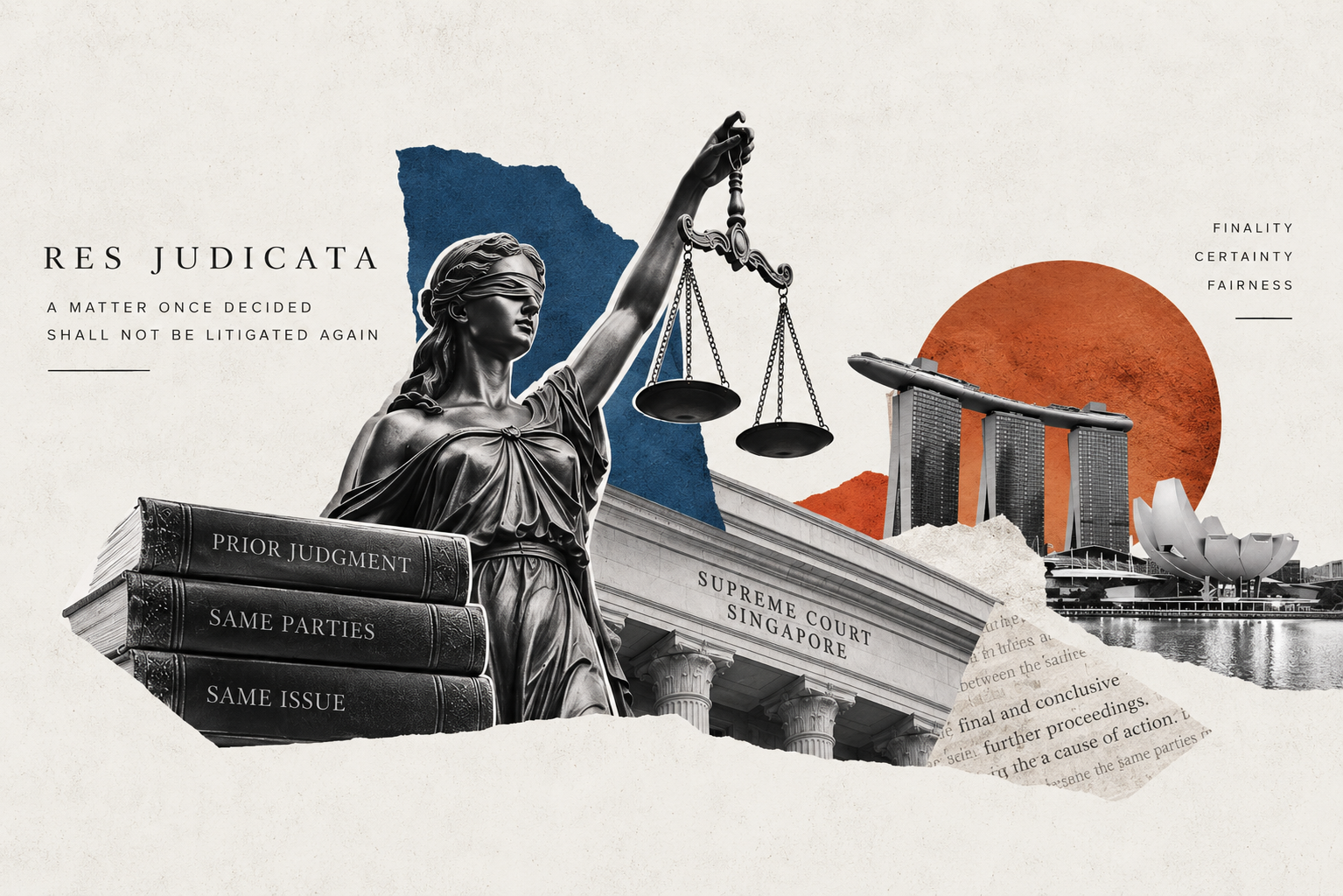
The "One Bite of the Cherry" Rule: Why You Can’t Be Sued Twice for the Same Dispute
If you have ever been involved in a legal dispute, you know that the process can be stressful, time consuming, and expensive. Whether you are a small business owner defending against an unpaid invoice claim or a consumer unhappy with a service, the one thing you want at the end of litigation is finality.
But what happens if the person suing you loses, and then simply tries to sue you again in a different court? Or what if they change their legal argument and attempt to bring essentially the same dispute again? What if they sue your company’s director, consultant or another related party instead, hoping for a different result?
Singapore law recognises that litigation cannot continue indefinitely.
At Netto & Magin LLC, we frequently help clients navigate the anxiety and cost caused by repeated legal proceedings. The law contains mechanisms that may prevent parties from improperly reopening matters which have already been determined.
One of the most important is the legal doctrine of res judicata.
Key Takeaways
- Res judicata promotes finality by preventing matters that have already been properly determined from being repeatedly litigated.
- Cause of action estoppel may prevent the same cause of action from being brought again between the same parties.
- Issue estoppel can prevent a specific issue of fact or law that was necessarily decided from being reopened.
- The extended doctrine of res judicata may apply even where an argument was not previously decided if it could and should reasonably have been raised earlier.
- Simply changing the legal label, introducing another closely connected party or commencing fresh proceedings does not necessarily allow a litigant to reopen an already resolved dispute.
- Whether res judicata applies depends heavily on the previous proceedings, the issues determined, the parties involved and the circumstances of the later action.
What is Res Judicata in Singapore?
Res judicata is a legal doctrine that serves two important public policy interests: ensuring finality in litigation and preventing individuals from being vexed repeatedly over matters that have already been determined.
The term res judicata essentially refers to a matter that has already been adjudicated.
In simple terms, it is the “no second bite of the cherry” rule.
If a competent court has already finally determined a dispute or a particular issue on its merits, a dissatisfied party generally cannot simply hit the reset button and ask another court to decide the same matter again.
This does not mean that every subsequent lawsuit involving similar facts will automatically be prohibited. Whether res judicata applies depends on matters such as what was actually decided in the earlier proceedings, whether the judgment was final, the identity of the parties, the cause of action or issue involved and the nature of the subsequent proceedings.
In Singapore, the doctrine broadly operates through three distinct but related principles:
Cause of action estoppel
Issue estoppel
The extended doctrine of res judicata, commonly associated with abuse of process
Understanding the difference between these three principles is important because they address different types of attempted relitigation.
Cause of Action Estoppel: The Absolute Bar
Cause of action estoppel prevents a party from asserting or denying a particular cause of action where the existence or non existence of that cause of action has already been determined by a competent court in previous litigation between the same parties.
In other words, if you sue someone on a particular cause of action and the court finally decides that claim, you generally cannot bring the same cause of action again simply because you are dissatisfied with the outcome.
For cause of action estoppel to apply, the court will generally consider matters including:
whether there was a final and conclusive judgment on the merits;
whether the earlier judgment came from a court of competent jurisdiction;
whether there is identity between the relevant parties; and
whether the same cause of action is being pursued again.
Where the requirements are satisfied, cause of action estoppel generally operates as an absolute bar to relitigation, subject to narrow circumstances such as fraud or collusion affecting the earlier judgment.
Can You Change the Legal Argument and Sue Again?
Changing the wording of a claim does not necessarily avoid res judicata.
Courts look beyond labels and consider the substance of the dispute.
A claimant cannot necessarily turn essentially the same complaint into a fresh lawsuit merely by describing the legal claim differently or introducing legal arguments that could have been made earlier.
This is particularly important in commercial disputes, where the same transaction might potentially give rise to arguments involving contract, misrepresentation, restitution, negligence or other legal causes of action.
The fact that a new legal expression is used does not automatically mean that the underlying dispute is new.
Singapore Case Example: The Failed Property Purchase
Consider a real Singapore case arising from a failed property transaction.
A purchaser had commenced proceedings relating to the return of a deposit after a property transaction did not proceed. An earlier Magistrate’s Court claim against the vendors seeking the return of the deposit had been struck out.
The purchaser later commenced another High Court action against the vendors involving claims for misrepresentation and breach of contract arising from the failed property transaction.
The later claim was also struck out, with the court applying principles of res judicata including issue estoppel.
The case illustrates an important principle: courts examine the substance and history of the dispute rather than simply asking whether a claimant has used different legal terminology in the new proceedings.
You cannot necessarily repackage an unsuccessful factual complaint under a new legal label and expect the entire dispute to begin again.
Issue Estoppel: The Specific Issue Bar
Cause of action estoppel deals principally with the cause of action itself.
Issue estoppel is different.
Sometimes, the later proceedings may involve a different overall cause of action, but a specific issue of fact or law has already been conclusively determined in earlier proceedings.
Issue estoppel can prevent that particular issue from being litigated again.
For example, suppose a court has already determined a fundamental factual issue concerning whether a particular contractual representation was made.
A party may not necessarily be permitted to ask another court to determine the exact same factual issue again simply because the later lawsuit relies on a different legal cause of action.
What Must Be Proven for Issue Estoppel?
For issue estoppel to apply in Singapore, four principal requirements generally have to be satisfied:
There must be a final and conclusive judgment on the merits.
The judgment must have been made by a court of competent jurisdiction.
There must be identity between the relevant parties.
There must be identity of the issue or subject matter sought to be relitigated.
Determining whether there is identity of subject matter requires more than identifying similarities between two lawsuits.
The court considers whether the earlier determination covered the same ground, whether that determination was fundamental rather than merely incidental to the earlier decision and whether the relevant issue was actually raised and determined.
This prevents issue estoppel from being applied too broadly.
What If the Previous Court Was Wrong?
One of the potentially surprising aspects of res judicata is that the doctrine is concerned not only with reaching the correct result, but also with ensuring that litigation eventually comes to an end.
A party generally cannot reopen a finally determined issue merely by arguing that the previous court reached the wrong conclusion.
Singapore law does recognise a very narrow exception to issue estoppel, sometimes referred to as the Arnold exception, but the requirements are stringent.
It is not enough simply to locate another document, develop a better argument or regret the way the previous case was conducted.
The exception is reserved for exceptional circumstances where strict requirements are satisfied and allowing the earlier determination to remain binding would cause serious injustice.
For most litigants, the practical lesson is straightforward: the first proceedings matter enormously.
Evidence and important legal arguments should be properly considered and presented when the dispute is first litigated.
The Extended Doctrine of Res Judicata: Abuse of Process
The third category is particularly important because it deals with a common question:
What happens if the argument was never actually decided in the first case?
A litigant might argue:
“I am not raising the same issue again. I am raising a completely new argument that I did not use the first time.”
That does not necessarily solve the problem.
The extended doctrine of res judicata may prevent a party from raising points in later proceedings that were not actually decided previously but which could and should reasonably have been raised in the earlier proceedings.
The principle originates from the idea that parties should bring their whole case forward rather than litigating disputes piece by piece.
However, the extended doctrine is more flexible than cause of action estoppel.
The court considers all the circumstances when deciding whether allowing the subsequent proceedings would amount to an abuse of process.
Relevant considerations may include whether the later proceedings effectively amount to a collateral attack on an earlier decision, whether there was a genuine reason why the issue was not raised earlier, whether new evidence exists and whether there are special circumstances justifying further proceedings.
The question is not merely whether it was theoretically possible to raise the issue earlier.
The court considers the substance and reality of the previous proceedings.
Can You Sue a Different Person After Losing the First Case?
This raises another important distinction.
Cause of action estoppel and issue estoppel ordinarily involve requirements concerning the identity of parties.
The extended doctrine of res judicata is more flexible.
In appropriate circumstances, the court may find an abuse of process even where the defendant in the later proceedings was not a party to the earlier case.
For example, imagine a business dispute where a claimant unsuccessfully challenges the valuation of a transaction.
After losing, the claimant does not sue the same contracting party again. Instead, the claimant commences a fresh lawsuit against the consultant whose report played a role in the valuation.
Changing the defendant does not necessarily mean that the new proceedings are immune from scrutiny.
If the new action is, in substance, an attempt to attack or reverse the result of the earlier proceedings, the court may consider whether it amounts to an abuse of process.
Singapore Case Example: The Blamed Consultant
A recent Singapore Court of Appeal case provides a useful illustration.
A seller and buyer were involved in a dispute concerning the valuation of a company. An independent human resources consultant had been appointed in connection with determining market benchmarks relevant to the valuation.
The dispute between the seller and buyer proceeded to arbitration.
The seller raised concerns regarding the consultant and subsequently attempted to challenge aspects of the arbitral outcome.
After those proceedings, the seller commenced a separate court action directly against the consultant. Among other things, the seller alleged misrepresentation and questioned whether the consultant had been genuinely independent.
The court dismissed the claims, including on the basis that the proceedings constituted an abuse of process in light of the previous arbitration and related court proceedings.
On appeal, the Singapore Court of Appeal upheld the application of the extended doctrine.
A significant point was that concerns about the consultant’s independence could and should have been pursued fully during the earlier arbitration.
The fact that the consultant was not itself a party to the earlier arbitration did not automatically prevent the extended doctrine from applying.
This illustrates an important distinction between the different branches of res judicata.
The extended doctrine is concerned with the overall fairness and proper use of the court process. The court may examine whether a later lawsuit is genuinely a new dispute or, in reality, an attempt to reopen or collaterally attack matters that should have been resolved previously.
Does Res Judicata Apply After Arbitration?
Potentially, yes.
The principles surrounding res judicata are not necessarily confined to a situation where both sets of proceedings are ordinary court lawsuits.
Depending on the circumstances, previous arbitration proceedings may become relevant when a party subsequently brings court proceedings concerning matters connected to what was already determined.
The precise analysis can be complicated because arbitration is based on party consent and the scope of an arbitral tribunal’s jurisdiction depends on the arbitration agreement.
Nevertheless, Singapore courts have recognised that later court proceedings can, in appropriate circumstances, amount to an abuse of process where they improperly attempt to reopen issues arising from previous arbitration proceedings.
This is especially relevant in commercial disputes where arbitration clauses are common.
What Happens If Res Judicata Applies?
Where a defendant believes that proceedings improperly attempt to relitigate an earlier dispute, the defendant may seek to have the claim struck out.
Under Singapore’s civil procedure rules, the court has powers to strike out pleadings where, among other grounds, they constitute an abuse of the process of the court or where striking out is in the interests of justice.
A successful res judicata or abuse of process argument can therefore potentially bring inappropriate repeat litigation to an end without requiring the parties to conduct another full trial on the underlying dispute.
However, whether a claim should be struck out depends on the circumstances.
Simply asserting that “this matter has already been decided” is not sufficient.
The previous judgment, pleadings, issues, parties and procedural history may need to be carefully examined to establish what was actually determined and whether the legal requirements are satisfied.
Can New Evidence Allow You to Reopen a Case?
Not automatically.
Discovering additional evidence after losing a case does not necessarily entitle a party to commence fresh proceedings concerning the same dispute.
The law places considerable importance on finality.
Courts may consider whether evidence genuinely could not have been obtained earlier despite reasonable diligence, but the availability of new evidence does not by itself erase the effect of an earlier final judgment.
This is why evidence gathering before and during the first proceedings is so important.
Parties should generally avoid holding documents, witnesses or legal arguments in reserve with the expectation that they can use them in another lawsuit if the first case is unsuccessful.
Why Does Singapore Law Prevent Repeated Litigation?
Res judicata is not simply a procedural technicality designed to make litigation more difficult.
There are broader reasons behind the doctrine.
First, successful parties should generally be entitled to rely on the finality of judgments. A person who successfully defends a lawsuit should not ordinarily be forced to defend substantially the same dispute repeatedly.
Second, repeated proceedings consume judicial resources.
Third, allowing endless relitigation could undermine confidence in the court system. If every final judgment could simply be challenged indirectly through another lawsuit, disputes might never genuinely end.
At the same time, Singapore courts recognise that the doctrine must be applied carefully.
The objective is not to prevent legitimate new claims from being heard. It is to distinguish genuine disputes from attempts to obtain another opportunity to litigate matters that have already been, or reasonably should have been, resolved.
Frequently Asked Questions About Res Judicata in Singapore
Res judicata broadly refers to the principle that a matter which has already been finally adjudicated should not ordinarily be litigated again.
In Singapore, the doctrine includes cause of action estoppel, issue estoppel and the extended doctrine of res judicata.
Not every second lawsuit is automatically prohibited simply because it concerns similar facts.
However, where the same cause of action or an issue has already been finally determined between the relevant parties, res judicata may prevent the matter from being litigated again.
The extended doctrine may also apply where the later proceedings constitute an abuse of process.
Not necessarily.
The court examines the substance of the previous and subsequent proceedings.
Changing a legal label does not automatically create a genuinely new dispute, particularly where the relevant issue or cause of action has already been determined.
Cause of action estoppel and issue estoppel generally involve requirements relating to identity of parties.
However, the extended doctrine of res judicata may, depending on the circumstances, apply even where the parties are not identical.
The court will consider whether the later proceedings amount to an abuse of process when viewed against the history and substance of the dispute.
Potentially.
Singapore courts have recognised that the extended doctrine of res judicata may apply in the context of previous arbitration proceedings.
Whether it applies depends on matters including the scope of the arbitration, the issues previously raised, the parties involved and whether the subsequent court proceedings are effectively a collateral attack on what happened earlier.
The threshold is high.
Merely discovering additional evidence does not automatically permit an already determined issue to be reopened.
Any exception to the ordinary rules of finality is narrowly applied and highly dependent on the facts.
A lawyer can review the earlier judgment and proceedings, compare them against the new claim and advise whether cause of action estoppel, issue estoppel or abuse of process may provide a basis for challenging the new proceedings.
Early action may also be important if an application to strike out the proceedings is being considered.
The takeaway
In litigation, you must put your best foot forward the first time.
You generally cannot keep evidence or legal arguments in reserve for a second attempt simply because the first case did not produce the outcome you wanted.
Likewise, if you find yourself facing a lawsuit over an issue that has already been decided, you may not have to fight the entire battle all over again.
The doctrines of cause of action estoppel, issue estoppel and abuse of process exist to balance two important principles: giving parties a fair opportunity to present their case and ensuring that litigation eventually comes to an end.
Whether res judicata applies, however, is highly dependent on the precise history of the dispute.
The earlier pleadings, judgment, parties, causes of action and issues determined may all be relevant.
Early legal intervention is therefore important in identifying whether an opponent is improperly attempting to reopen a dispute and whether an application to strike out the proceedings may be available.
Contact Netto & Magin LLC if you are facing repeated litigation or believe that a claim concerns matters that have already been determined. Our lawyers can review the previous proceedings and advise you on the appropriate steps to protect the finality of the earlier outcome.
This article provides general information on res judicata and civil litigation in Singapore and should not be treated as legal advice for any particular case.

Netto & Magin LLC
Netto & Magin LLC is a boutique law firm in Singapore, boasting over 50 years of proven experience. Our specialized expertise covers Family Law, Corporate Law, Employment Law, Fraud Cases, and Commercial and Civil Litigation. With a dedicated team of industry-leading experts located strategically in Singapore's central business district, we stand ready to serve as your trusted legal partner.
Contact us for a free consultation.